- 26 Dec 2025
- Psy. Ashish Pandey
Love Marriage vs Arranged Marriage
Love Marriage vs Arranged
Marriage
One of the most important social structures in human existence is marriage. It
brings families, customs, and values together in addition to two people. There
are two main types of marriage in most cultures, particularly in nations like
India: arranged marriage and love marriage. Both systems have been in place for
centuries and continue to have distinct effects on society. Arranged marriages
prioritize social compatibility and family engagement, whereas love marriages
emphasize individual choice and emotional connection. Each has its own
benefits, difficulties, and applicability in the contemporary environment.
Marriage out of love
Love Marriage
A love
marriage is one in which two people marry because they love, are attracted to
each other, understand each other, and have mutual consent. In this
arrangement, the pair usually meets independently—through school, college,
employment, or social interactions—and decides to marry without the primary
family's approval.
Advantages of Love Marriage:
Emotional bonding is one of the most valuable aspects of a love marriage.
Because the couple already knows each other well, they frequently share common
interests, ambitions, and values. This shared understanding can result in
improved communication and fewer misunderstandings following marriage.
Love
marriages also encourage personal independence and equality. Partners feel
appreciated because the decision to marry is their own. This can boost
confidence, trust, and a feeling of partnership in the relationship.
Another benefit is current compatibility. In today's fast-changing world, love
marriages allow people to find partners who share their lifestyle, career
goals, and personal convictions, which can help them adjust to married life.
The disadvantages of a love marriage
Love marriage, despite its benefits, is not without its obstacles. One big
difficulty is a lack of familial support, particularly in traditional cultures.
Opposition from parents and relatives might cause emotional distress in the
marriage.
Love marriages can often be tough when romantic expectations clash with
reality. Love before to marriage may not always prepare couples for
responsibilities such as economics.
Differences
in culture, religion, or social background can also lead to conflict if not
handled with maturity and understanding.
Arranged Marriage
Arranged
marriage is a system in which families play an important role in finding a
compatible match for their child. While the bride and groom's ultimate consent
is increasingly appreciated nowadays, family guidance remains an important
consideration.
Advantages of Arranged Marriage
One of the most significant advantages of arranged marriage is strong family
support. Because families are involved from the start, the couple frequently
receives advice, financial assistance, and emotional support, which helps
enhance their marriage.
Arranged marriages also prioritize social and cultural compatibility. Religion,
caste, traditions, education, and family values are all taken into account,
which can help to prevent conflicts over to lifestyle and customs.
Another advantage is long-term stability. Many planned marriages prioritize commitment, patience, and mutual adjustment over passionate sentiments. Love and understanding frequently evolve organically over time.
The disadvantages of a love marriage
One important disadvantage of arranged marriage is that it limits personal
choice. In rare circumstances, individuals may feel compelled to accept a
spouse chosen by their family, even if they are uncertain.
There may also be a lack of emotional connection at first because the couple
did not know each other well before to marriage. This can make initial
adjustment difficult.
In extreme cases, traditional arranged marriages can ignore personal
compatibility, leading to dissatisfaction or unhappiness if open communication
is lacking.
The disadvantages of arranged marriages
One important disadvantage of arranged marriage is that it limits personal
choice. In rare circumstances, individuals may feel compelled to accept a spouse
chosen by their family, even if they are uncertain.
There may also be a lack of emotional connection at first because the couple
did not know each other well before to marriage. This can make the initial
transition tough.
In extreme circumstances, traditional planned marriages may overlook personal
compatibility, resulting in discontent or sadness if open communication is
lacking.
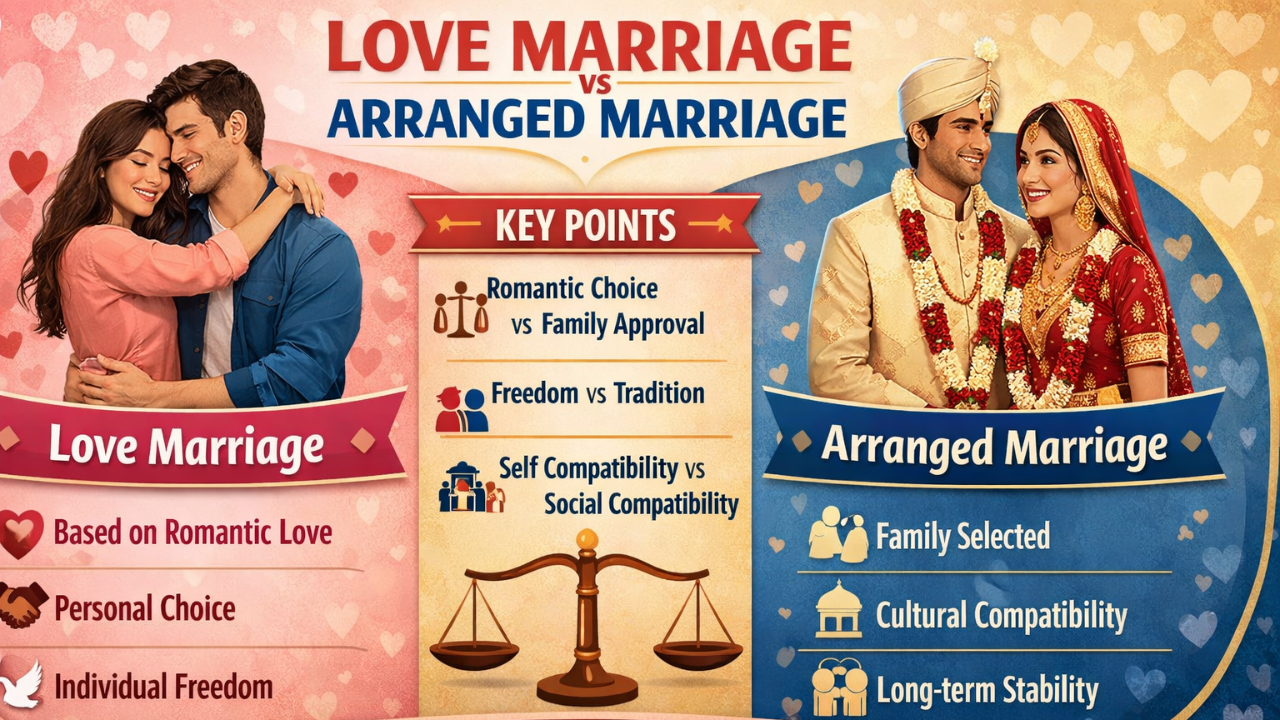
Love Marriage versus Arranged Marriage: Comparison
Love
marriage values individual choice and personal connection, whereas arranged
marriage focuses on family involvement and social harmony. Love marriages may
begin with intense romantic feelings, but they take effort to maintain
long-term stability. Arranged marriages may begin with little familiarity, but
they frequently strengthen through shared responsibilities and family support.
In today's society, the distinction between the two is becoming less clear.
Many marriages nowadays are a hybrid of the two systems, with people selecting
their spouses and families giving their blessing. This balanced approach blends
love and tradition, independence and guidance.
Conclusion
Love marriage and arranged marriage have their own advantages and
disadvantages. Neither approach is ideal, and a marriage's success is not
determined only by how it began. Respect, trust, communication, and mutual
understanding are the essential cornerstones of a successful and long-lasting
marriage.