- 02 Dec 2025
- Psy. Ashish Pandey
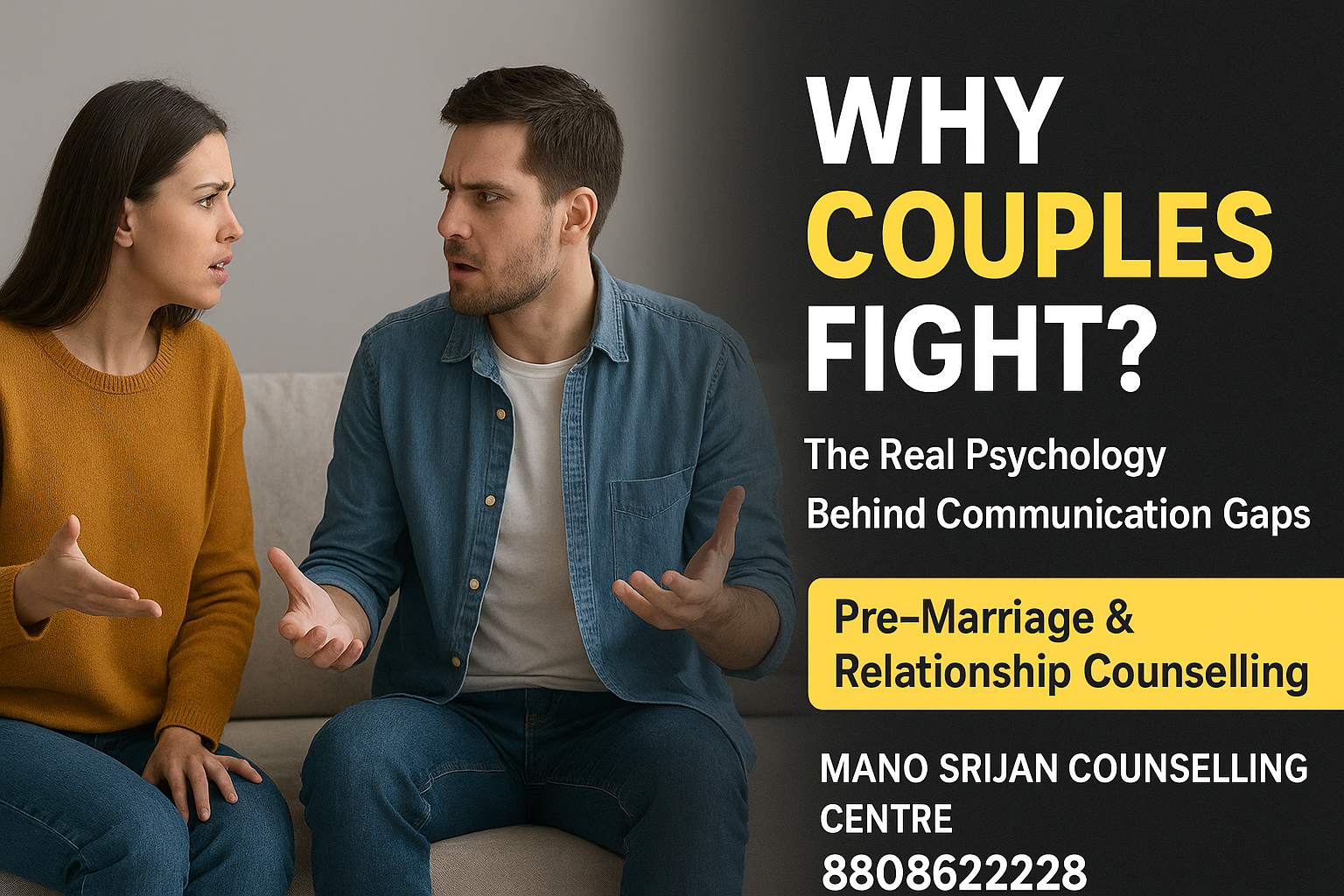
Why Couples Fight: The Real Psychology Behind Communication Gaps
The question
most couples ask is: “Why do we fight so much, when we love each other?”
The solution lies deep inside human psychology—specifically in how we interact,
how we perceive emotions, and how our past experiences impact our present
reactions.
This essay addresses the real psychology behind communication gaps in
relationships and how these gaps lead into arguments, frustration, and
emotional anguish. Additionally, we'll talk about research-based and useful
methods for developing better communication habits.
________________________________________
1. The
Root of Most Fights: Miscommunication, Not Lack of Love
Most couples argue because they don't fully understand one another rather than
because they don't love one another. Psychological study demonstrates that
couples typically assume they know what the other person means—but in
actuality, their comprehension is mediated through:
• Prior encounters
• Expectations
Communication methods; emotional injuries
A simple remark like “You never listen” may convey something very different to
each partner.
• One may hear: “I am failing.”
• The other may mean: “I am not feeling heard.”
This difference in meaning produces emotional friction.
________________________________________
2. Childhood Experiences Shape Adult Communication
We don't
develop our communication style as adults. It has its roots in family
interactions and childhood.
Styles of Attachment
Attachment is divided into four main categories by psychologists:
1. Secure Attachment
o Communicates openly o Trusts partner o Handles conflicts calmly
2. Anxious Attachment o Overthinks o Requires assurance o Misunderstands
silence as rejection
3. Avoidant Attachment o Avoids emotional conversations o Feels uncomfortable
with vulnerability o Withdraws during confrontation
4. Avoidant-Fearful Attachment
Wants intimacy but is afraid of getting hurt; acts in a hot or cool manner; and
has a lot of conflict
Misunderstandings are more common in couples with opposing attachment patterns.
For example: • An anxious spouse wants to communicate immediately. • An
avoidant partner needs room to consider.
To each other, both seem wrong—but mentally, both are defending themselves.
________________________________________
3. Emotional
Triggers: Why Small Issues Become Big Fights
A “trigger” is an emotional recollection evoked by the current situation. Among
the minor triggers are: • Voice tone
• The expression on the face
• A specific word; • Not hearing back; • Feeling disregarded
People react emotionally rather than rationally when they are triggered. This
is why couples fight about topics that appear “small”:
• A delayed response; • Not returning calls; • Forgetting something; • A
negative attitude
The issue is rarely the incident—it is the emotion tied to it. For example:
• "I feel unimportant to you" could be implied by "You didn't
text me back."
• "You never help me" might signify "I need help because I'm
tired."
Understanding the underlying emotion eliminates unneeded conflict.
________________________________________
4. The
Most Common Communication Errors Couples Make 1. Mind Reading (Assuming Rather
Than Asking) Partners believe the other person "should know" how they
are feeling.
"I shouldn't have to tell you I am upset," for instance.
In actuality, though, nobody is able to read minds.
2. Using “You Statements” Instead of “I Statements”
• “You
never listen.”
• "You never pay attention to me."
Defensiveness is triggered by these statements.
An improved strategy would be to say, "I feel unheard when we talk."
3. Reacting Instead of Responding
When emotions are high, the brain’s thinking ability becomes low. Reacting
causes shouting, blaming, or retreating.
4. Including Issues from the Past in Current Conflicts
Wounds from the past resurface:
•
"You did the same thing last time."
• “You always do this.”
This
escalates conflict and prevents solutions.
5. Anticipating Our Partner's Behavior
Individuals vary in:
• Expressing love • Understanding emotions • Solving problems • Handling stress
Expecting sameness generates disappointment.
________________________________________
5. Why Couples Struggle to Express Their Feelings
Many people dread displaying vulnerability because: • They fear rejection •
They fear being misunderstood • They fear being weak • They fear conflict •
They fear hurting their spouse
Therefore, they display secondary emotions like anger, sarcasm, silence, and
withdrawal rather than the true emotions, such as hurt, fear, and loneliness.
This creates distance.
________________________________________
6.
Gender-Based Communication Differences (Scientifically Proven)
While every individual is different, evidence suggests:
Men commonly:
• Communicate to solve difficulties
• Avoid emotional topics • Feel overwhelmed by emotional intensity • Need more
time to analyze feelings
Women commonly: • Communicate to convey connection • Want emotional validation
• Expect more verbal engagement • Want immediate clarity
Classic conflicts result from these differences:
"Talk to me," said the woman.
"Give me time," said the man.
Both feel misunderstood.
________________________________________
7. Gottman's Research on the Four Toxic Communication Patterns
Relationship expert Dr. John Gottman identified four behaviors that can
foreshadow separation if not corrected:
1. Criticism
focusing on personality rather than behavior.
2. Disdain
The worst kind is sarcasm, mockery, and disdain.
3. Being defensive
defending rather than comprehending.
4. Stonewalling
Shutting down, quiet treatment
If these
become patterns, relationships start feeling uncomfortable emotionally.
________________________________________
8. How Communication Gaps Hurt the Relationship
1. Emotional Distance
Partners stop sharing feelings.
2. Assumptions Take the place of reality
Instead of asking, people guess—and guess poorly.
3. Over Time, Resentment Grows
Unspoken issues accumulate.
4. Trust Weakens
Trust diminishes when communication is perceived as hazardous.
5. Love Is Hard to See
Even when love exists, it becomes impossible to feel.
________________________________________
9. How Couples Can Fix Communication Gaps—Scientifically Proven Strategies
Here are research-backed techniques to improve communication:
________________________________________
Using the "Pause Technique" in combat is the first tactic.
Take a 10- to 20-minute pause when your emotions start to escalate.
The rule: • No shouting • No walking away angrily • No disregarding
Calm your mind and return to the conversation with clarity.
________________________________________
Strategy
2: The “I Feel” Formula
Put emotion in place of blame.
Rather than:
"You're not concerned."
Say: "When you don't reply, I feel lonely."
This turns the debate from attack to explanation.
________________________________________
Strategy 3: Listen to Understand, Not to Respond
Most people listen merely to reply.
The reverse is true for healthy partnerships.
Procedure:
1. Allow your partner to finish speaking.
2. Restate what you comprehended.
3. Acknowledge their emotions.
Validation is comprehension, not agreement.
________________________________________
Strategy 4: Avoid Absolute Words (“Always”, “Never”)
Defensiveness is increased by these words.
Replace them with specific instances.
________________________________________
Establish "Communication Rules" as the fifth strategy.
Healthy rules:
There
should be no yelling, insults, or threats.
• No walking away
• Avoid discussing separation out of rage.
These guidelines establish emotional safety.
________________________________________
Strategy 6: Weekly Relationship Meeting
Once a week, discuss: • What went well • What needs improvement
• Needs related to emotions
• Levels of stress
This keeps problems from getting worse.
________________________________________
Learn Each Other's Love Languages (Strategy 7)
People show love in 5 major ways:
1. Words of affirmation
2. Time for quality
3. Touching
4. Serving others
5. Gifts
Couples can communicate more easily when they are aware of each other's love
language.
________________________________________
10. Differences in Communication Styles and How to Address Them
1. Expressive vs. Reserved
Open communication is a sign of expressive couples.
Reserved couples need time.
Solution: Give space but also set a time to talk.
________________________________________
2.
Problem Solver vs. Emotional Processor
One seeks solutions.
One desires to communicate their emotions.
Solution: First, exhibit empathy.
Then on to problem-solving.
________________________________________
3. Fast Thinker vs. Slow Thinker
Some process fast; others take time.
Solution: Do not pressure.
Allow thinking time.
________________________________________
4. Practical vs. Emotional
Practical partners prioritize rationality.
Feelings are given priority by emotional partners.
Solution: Balance both opinions.
________________________________________
11. The Reasons Behind Partners' Feelings of "I Am Not Being Heard"
Even when we talk, the other person may not feel heard if:
• They
don’t receive eye contact
• Their
sentiments are dismissed
• They
are interrupted
• Their
tone is misunderstood
• Their
emotions are termed “overreaction”
Emotional
safety is more vital than precise communication.
________________________________________
12. Ego's Function in Communication Deficits
Ego prevents:
• Apology
•
Compromise
•
Vulnerability
•
Admitting mistakes
•
Initiative to overcome dispute
Ego says: “Why should I talk first?”
"Why should I apologize?"
"Let's fix this together," says love.
Couples that prioritize connection over ego establish stronger relationships.
________________________________________
13. Technology and Communication Gaps
• Delayed
replies
•
Misinterpretation of texts
•
Overthinking messages
•
Excessive social media use
• Lack of
meaningful time
If technology is not used carefully, it might cause emotional estrangement.
________________________________________
14. When Interaction Gaps Become Toxic
Signs include: • Frequent misunderstandings • Every discourse becomes a fight •
Repeated disputes about the same issue • Avoidance instead of discussion •
Constant emotional pain • Feeling alone in the relationship
At this stage, professional counselling becomes beneficial.
________________________________________
15. How
Pre-Marriage Counseling Improves Communication Between Couples Pre-marital
counseling instructs partners:
• Emotional awareness
• Ability to resolve conflicts;
•
Knowledge of family history;
• Role
expectations;
•
Communication styles;
• Anger
control;
•
Financial communication;
• Future
planning
It prepares couples to understand each other before issues develop.
________________________________________
In conclusion
Couples do not argue because they lack love—they fight because they lack
clarity, understanding, and emotional safety in communication. Most
disagreements come from:
•
Misinterpretations
• Fear of
vulnerability
•
Emotional triggers
•
Different communication styles
• Childhood patterns
• Ego
fights
The good news is this: Communication is a skill, not a personality
characteristic.
Any couple may learn to speak with empathy, respect, and emotional maturity
with awareness and practice.
Relationships are transformed by effective communication.
It transforms disagreements into strength, disagreements into understanding,
and love into a stable emotional connection.